
Seed saving is an essential practice for sustainable vegetable gardening, allowing you to select and propagate the highest-performing plants year after year. It’s a fantastic way to save money, make your garden more sustainable, and ensure you are growing varieties perfectly suited to your garden’s specific microclimate.
The core principle is simple: you just mimic what happens in nature by allowing the fruit or flower containing the seeds to fully mature on the plant and then taking similar steps to what would have happened naturally.
Key Principles for Seed Saving Success
To maximize next year’s harvest, focus on quality over quantity:
- Select the Best Performers: Only save seeds from the healthiest, most vigorous plants. This effectively ensures that you select locally adapted plant varieties that naturally thrive in your microclimates, such as sunlight levels, clay soil or a shorter growing season.
- Plan Ahead: Proactively choose which plants will be designated for seed production, rather than waiting until the end of the season to save seeds from the last few remaining vegetables – which will be less healthy than in peak season.
- Understand Lifecycles: For successful seed saving, differentiate between plant types:
- Annuals: The easiest to save (e.g., tomatoes, peppers, beans, squash). They complete their cycle from seed to seed in one growing season.
- Biennials: These require two growing seasons (approximately 1.5 years) to produce seed (e.g., carrots, kale, onions, beets). They must be successfully overwintered to flower and set seed in the second year.
- Perennials: These require multiple growing seasons before they reliably produce seed (e.g., fruit trees, berries, and herbs in the mint family).
For more on selecting varieties, review our guide on Seeds: Open-Pollinated vs Hybrid.
Avoiding Cross-Pollination
A primary risk for seed savers is cross-pollination, where pollen from a different variety contaminates the seed. If this occurs, the saved seeds will be hybridized, producing an unpredictable plant the following year.
To prevent unwanted hybrids:
- If you do save seeds from plants at risk of cross-pollination (e.g., squash and zucchini) then aim to manually pollinate them using a paintbrush before the insects find the flowers.
- Avoid planting members of the same plant genus near one another, as pollinating insects can travel significant distances and can accidentally transfer pollen between different species and genera.
- Only save seeds from varieties with low cross-pollination risk (like tomatoes, peppers, beans and peas) or from plants that are sufficiently isolated.
Saving Seeds of Fruiting Vegetables
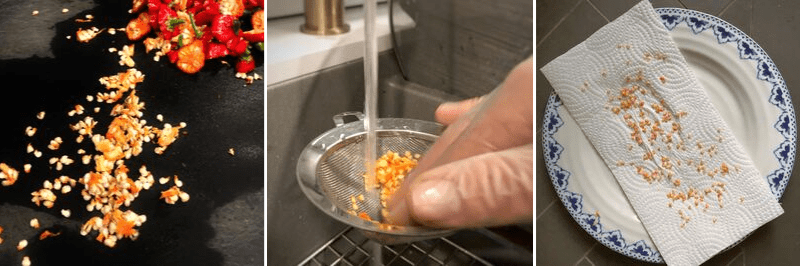
For plants like peppers, squash, and most fruits, the process is straightforward:
- Lay the clean seeds out on wax paper or a screen to dry completely for several days.
- Allow the best fruit to fully ripen, often past the point of edibility.
- Harvest the mature fruit and scoop out the seeds.
- Rinse the seeds in a colander to remove any pulp or material that retains moisture.
Exceptions for Fruiting Vegetables

Tomatoes and Cucumbers (Fermentation Method):
- Scoop the seeds and pulp into a glass with room-temperature water.
- Loosely cover it to allow for a small amount of air flow.
- After about seven days, viable seeds will sink to the bottom, and a layer of mold or congealed matter will form on top.
- Discard the top layer and any floating seeds.
- Rinse the remaining viable seeds and dry them thoroughly.
Beans and Peas:
- Leave some seed pods on the plant until they dry out.
- Once the plant has mostly dried up, cut the stem and hang the plants upside down. This allows the last remaining nutrients to transfer to the seeds.
- After everything is fully dry, shell the seeds from the pods.
Saving Seeds from Non-Fruiting Vegetables

This process applies to crops like lettuce, kale, and other leafy greens.
- Allow one or two of your best plants to bolt (produce a flower stalk).
- Let the flowers mature and dry fully on the plant before you pick them.
- Rub the dried flower heads or pods in the palms of your hands to separate the seeds from the chaff (the light, dry material).
- Pick out and collect the pure seeds.
To learn more about maximizing your harvest of leafy greens, see our guide on Planting Cool Crops.
Storing Your Saved Seeds
To ensure high viability for future gardening seasons, keep your seeds dormant:
- Avoid Germination Triggers: Seeds germinate when exposed to warmth, moisture, and sometimes light. Therefore, your storage should be the opposite: cool, dry, and dark.
- Location: Store your thoroughly dried seeds in an airtight container in a cool, dark place, such as a refrigerator or a dedicated storage area.
Ready to Grow More?
Join our community of gardeners and start growing your own food in the city! From balcony boxes to backyard plots, community gardens, and urban farms, we’re dedicated to helping you succeed in vegetable gardening and urban agriculture.
- In the Greater Toronto Area (GTA)? Join Our Program at Downsview Park: Enroll in our full-season Grow Veggies program for hands-on learning and a share of the harvest.
- Get Monthly Tips: Sign up for our monthly Grow With Us newsletter to receive seasonal tips and our gardeners’ to-do lists.
- Follow Us: Find us on Instagram or Facebook to see what we’re growing at our teaching garden in Toronto.
 Homestead T.O.