
Understanding your soil is the single most important action you can take to ensure a successful vegetable gardening season. Your soil is where plants access the majority of their water, oxygen, and nutrients and improving your soil is the best investment that you can make in your garden.
Soil testing reveals your soil’s composition, allowing you to optimize the soil structure and replenish specific nutrients that were removed by previous crops or leached away by rain. We recommend assessing your soil in the late fall or early spring to allow time for any necessary amendments to “fix” (change to a form that is available to your plants) before planting begins.
Testing Your Soil at Home: Drainage, pH and Texture
You can conduct simple tests at home to get a foundational understanding of your growing medium. This is especially helpful if you are dealing with heavy clay soil in the Toronto and GTA gardening regions.
1. Soil Drainage Assessment
Your soil’s drainage levels affect your plants’ ability to extract oxygen from the soil, which is a huge factor in a plant’s growth.
- Testing the Drainage: Is as simple as digging a 12” hole, filling it with water twice, and timing how long it takes to drain. The first fill of water is to saturate the soil around the test hole. Once it drains, fill it with water again and time how long it takes for the second batch of water to substantially drain.
- Target Range: If your soil drains too quickly, it affects its ability to retain moisture and nutrients. If it drains too slowly, it affects its ability to form small air pockets that hold oxygen. The ideal drainage time is 30-90 minutes..
- Practical Tip: Do the drainage test in mid-autumn or mid-spring when the ground is neither too cold nor too warm so as not to bias the results.
2. Soil pH Testing
The pH level tells you the acidity of your soil, which directly affects which nutrients are available to your plants.
- Testing Method: Test kits or soil pH meters are available at any garden centre.
- Target Range: For a successful, diverse vegetable garden, aim for a pH level of 6.5 to 6.8.
- Crop Needs: Note that this range varies by vegetable:
- Fruit-bearing plants (like tomatoes) prefer slightly more acidic soil (pH 6.0–7.0). Acidic soil also helps plants take in micronutrients like copper, boron, and zinc, which drive much of the flavour of your harvest.
- Leafy plants (like lettuce), alliums, and cruciferous vegetables prefer neutral soil (pH 6.5–7.5).
- Practical Tip: Soil naturally becomes more alkaline as it cools, so keep this in mind when testing in the early spring or late fall. For more detail, see our guide on The Importance of pH Levels.
3. Soil Texture Assessment
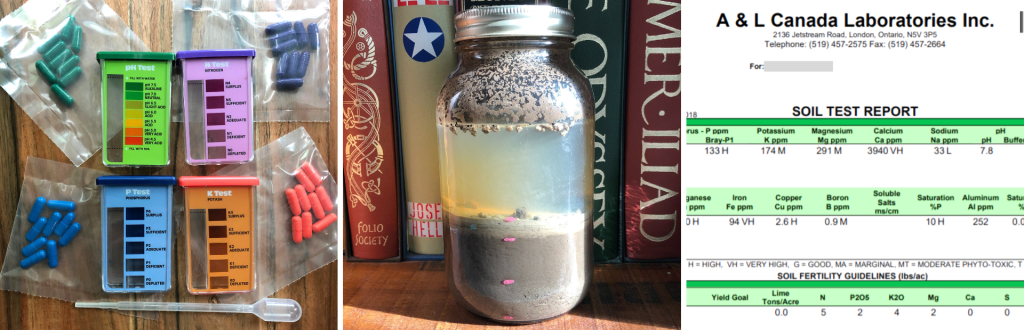
To understand the balance of sand, silt, and clay soil in your gardening plot, you can perform a simple Mason Jar Test. A good soil structure requires a mix of particle sizes to balance porosity (air pockets for oxygen) and density (stability and nutrient retention).
- Why Texture Matters: Ontario gardens often have high amounts of clay, which can compact easily and limit a plant’s access to oxygen.
- How to: Collect a soil sample, mix it with water in a mason jar until it is a slurry, and let it settle for 24 hours. The layers that form (sand, silt, clay, in that order from bottom to top) will reveal your soil’s composition. Measure and calculate the three layers and cross-reference these against the soil texture pyramid (easily found online) to determine your soil type.
- Ideal Soil Texture: Most broad-based vegetable gardens do best in a loamy soil type.
- Amendment Focus: If your soil is primarily clay, you will need to amend it with organic matter to break up the dense particles and improve drainage. For more information on improving texture, consult our guide on Soil Preparation.
In-Depth Lab Soil Analysis
For a truly detailed assessment of your vegetable garden soil, a professional laboratory analysis is the optimal choice.
What a Lab Test Provides: A lab test provides comprehensive metrics far beyond simple kits, including:
- Macronutrient Levels: Precise levels of Nitrogen (N), Phosphorus (P), and Potassium (K).
- Micronutrients: Details on calcium, magnesium, copper, boron, and sulphur, which are vital for plant health and flavour.
- Organic Matter Percentage: This metric is crucial for soil health, particularly in managing clay soil.
How to Take a Sample:
- Take samples from a few different spots in your garden.
- Use sterile or plastic tools to prevent mineral contamination from metal tools.
- Always sample soil from 2 to 6 inches below the surface (at root level), not just the top layer.
- Combine the samples and remit to a reputable lab (such as A&L Laboratories or the University of Guelph).
These detailed results are invaluable for developing your Garden Planning strategy and determining exactly what amendments you need to add, allowing you to have balanced soil and saving you money on unnecessary fertilizers. Consult our guide on What Plant Nutrients Do and How to Fertilize for a breakdown of the nutrients needed at each stage of the growing season.
Ready to Grow More?
Join our community of gardeners and start growing your own food in the city! From balcony boxes to backyard plots, community gardens, and urban farms, we’re dedicated to helping you succeed in vegetable gardening and urban agriculture.
- In the Greater Toronto Area (GTA)? Join Our Program at Downsview Park: Enroll in our full-season Grow Veggies program for hands-on learning and a share of the harvest.
- Get Monthly Tips: Sign up for our monthly Grow With Us newsletter to receive seasonal tips and our gardeners’ to-do lists.
- Follow Us: Find us on Instagram or Facebook to see what we’re growing at our teaching garden in Toronto.
 Homestead T.O.